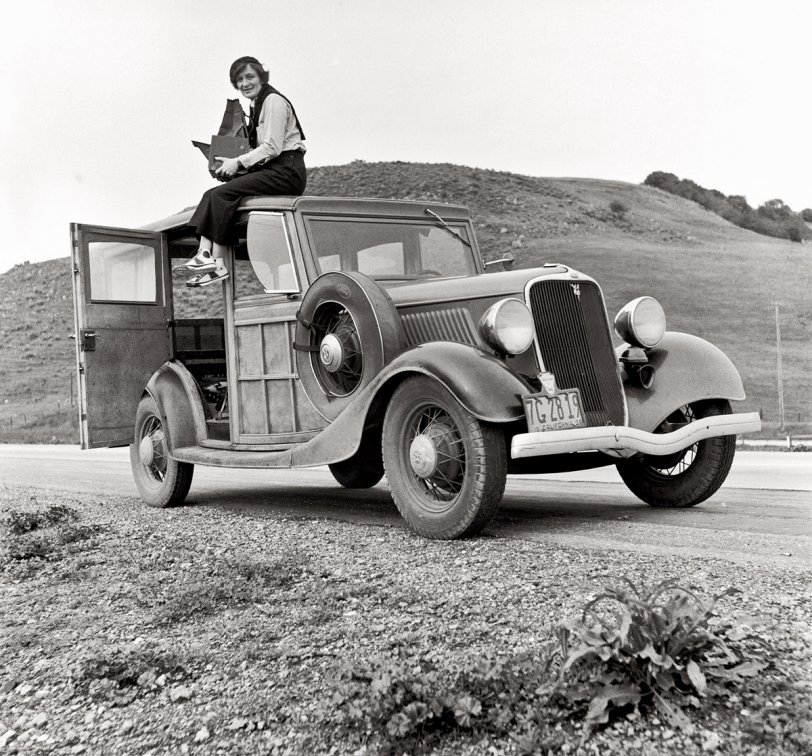
 Dorothea Lange was an American documentary photographer and photojournalist. She was born in Hoboken, New Jersey on May 26, 1895. She as born Dorothea Margaretta Nutzhorn. She changed her last name to her mother’s maiden name. She did this because her father abandoned her and her mother when she was twelve years old. Lange also was diagnosed with polio at age seven. This left her with a permanent limp in her right leg. Lange was taught photography by Clarence H. White. She also worked as an apprentice for several New York photography studios. In 1918, she moved to San Francisco where she opened a successful portrait studio. In San Francisco she met her first husband Maynard Dixon, who was a western painter. She had two sons with Dixon, Daniel Rhoades Dixon and John Eaglesfeather Dixon. During the Great Drepression Lange started to document unemployed and homeless people in the streets. These photos led her to a job with employment with the federal Resettlement Administration (RA), later called the Farm Security Administration (FSA).
 By December of 1935 she had divorced her husband and remarried to an agricultural economist named Paul Schuster Taylor. He was the Professor of Economics at the University of California. Together, the two documented rural poverty and the misuse of sharecroppers and migrant laborers. Taylor interviewed and gathered economic data while Lange took photos. During this project Lange took her most famous photo which is titled "Migrant Mother." The woman in the photo is Florence Owens Thompson. In 1941 Lange was awarded the Guggenheim Fellowship Award for excellence in photography. However, after the attack on Pearl Harbor, she gave up the award to record the forced evacuation of Japanese Americans to relocation camps, on assignment for the War Relocation Authority (WRA). In her photos she documented the gathering Japanese Americans being put in their internment in relocation camps. Her photos very critical of that Army impounded them. Today these photos can be found in the National Archives on the website of the Still Photographs Division, and at the Bancroft Library of the University of California.In 1945 Lange was invited by Ansel Adams to accept a position as faculty at the first fine art photography department at the California School of Fine Arts. In 1952, Lange co-founded a photographic magazine called Aperture. Lange was also was commissioned in the mid-1950s to shoot a photographic documentary for Life magazine of the death of Monticello, California and of the displacement of its residents by the damming of Putah Creek to form Lake Berryessa. The last two decades of her life she suffered in poor health. Lange finally died of esophageal cancer on October 11, 1965 at the age of 70. She was survived by her second husband, Paul Taylor, two children, three stepchildren, and numerous grandchildren and great-grandchildren.

No comments:
Post a Comment